

The transformation you’ve already made
Think about who you were ten years ago.
There’s something you do today that your ten-years-ago self would have found impossible. Not difficult. Impossible. You might have actually considered it and dismissed it entirely. And yet here you are, someone who figured it out.
How did that happen? You changed how you thought about yourself. You redefined what was possible for you, mapped out the steps, and took responsibility for the work of becoming someone new.
That process didn’t happen overnight. It didn’t happen alone. It happened inside communities – teams, friendships, institutions – and it was, by any honest measure, slow.
Now look at the pace of AI.
The pace of AI vs. the pace of people
The technology is moving at whiplash speed. Every few weeks, another capability that reshapes what’s possible. Organizations are under pressure to adopt, to scale, to automate. Playbooks are written. Budgets are allocated. Timelines are set.
And then the humans don’t move.
Not because they’re resistant or incapable. Because humans have always changed at a human pace. Rogers’ Diffusion of Innovations model tells us this clearly: some people lead, some people lag, and most of us are somewhere in the middle muddling through it. That middle is not a failure. It’s biology meeting reality.
The mistake many organizations make is treating AI adoption as a technology problem. Choose the right tools, build the right workflows, measure the right outputs. Important, yes. But it misses what’s actually happening in the people doing the work.
Why the technology-first approach falls short
William Bridges’ Transitions Model offers a more honest frame. His core insight: every transition begins with an ending. Not a beginning. An ending.
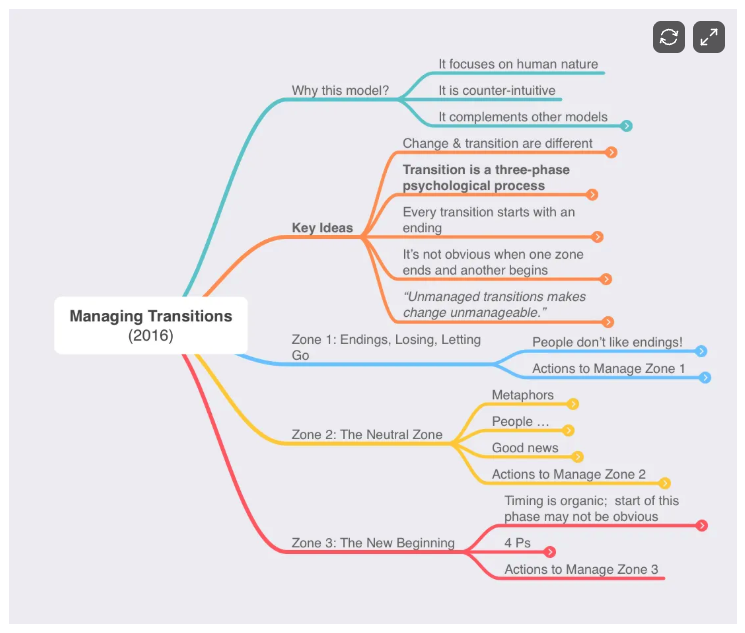
Before you can embrace a new identity – new skills, new roles, new ways of working – you have to grieve the identity you’re leaving behind. That grief is real. It shows up as hesitation, confusion, quiet resentment, or a low-grade dread you can’t quite name. It doesn’t mean you’re resistant. It means you’re human.
We’re watching this play out in real time. Layoffs tied to AI efficiency ripple far beyond the people who lose their jobs. The people who stay are watching. They’re recalibrating their own sense of worth, security, and purpose. They’re asking questions no productivity dashboard captures: Am I next? Does what I do still matter? Who am I in this new version of things?
Those questions deserve real answers. Not from a chatbot or a framework doc. From people who understand what you’re actually going through – who can say with credibility: here is what’s changing, here is why you still matter, and here is what you could become on the other side of this.
The real work of leadership
Holding space for that transition is some of the hardest leadership work there is. It’s also the prerequisite for everything else working.

Think about that person you imagined at the beginning – the one ten years ago who couldn’t have pictured where you are now. That transformation didn’t happen because the conditions were perfect or because the timeline was comfortable. It happened because you moved through the ending to get to something new.
That’s still how it works. The pace of AI is stunning. Humans change slowly because we change completely. The slowness is the work. What you’re feeling right now – the uncertainty, the disorientation, the grief – is the beginning of the transition, not proof that you’re falling behind. Ten years from now, someone will ask you how you navigated this moment. You’ll have an answer.
Think of a time at work when something ended — a tool, a process, a role. Was it handled well or poorly? What did leaders do or say that helped or hurt?