

As a mom of two Gen Z kids who has worked across five universities, I see this generation weighing cost, relevance, and ability to contribute meaningfully as a pragmatism that creates both opportunities and management challenges. Recent data from the Gallup/Walton Family Foundation survey of Gen Z young adults (18–28) illustrates this perfectly: 74% used an AI chatbot in the last month and 65% used one as a Google replacement. Yet 79% worry AI makes people lazier and 62% worry it makes people less smart—concerns clustered around “crowding out” learning‑by‑doing (68%), critical thinking (65%), and social learning (61%).
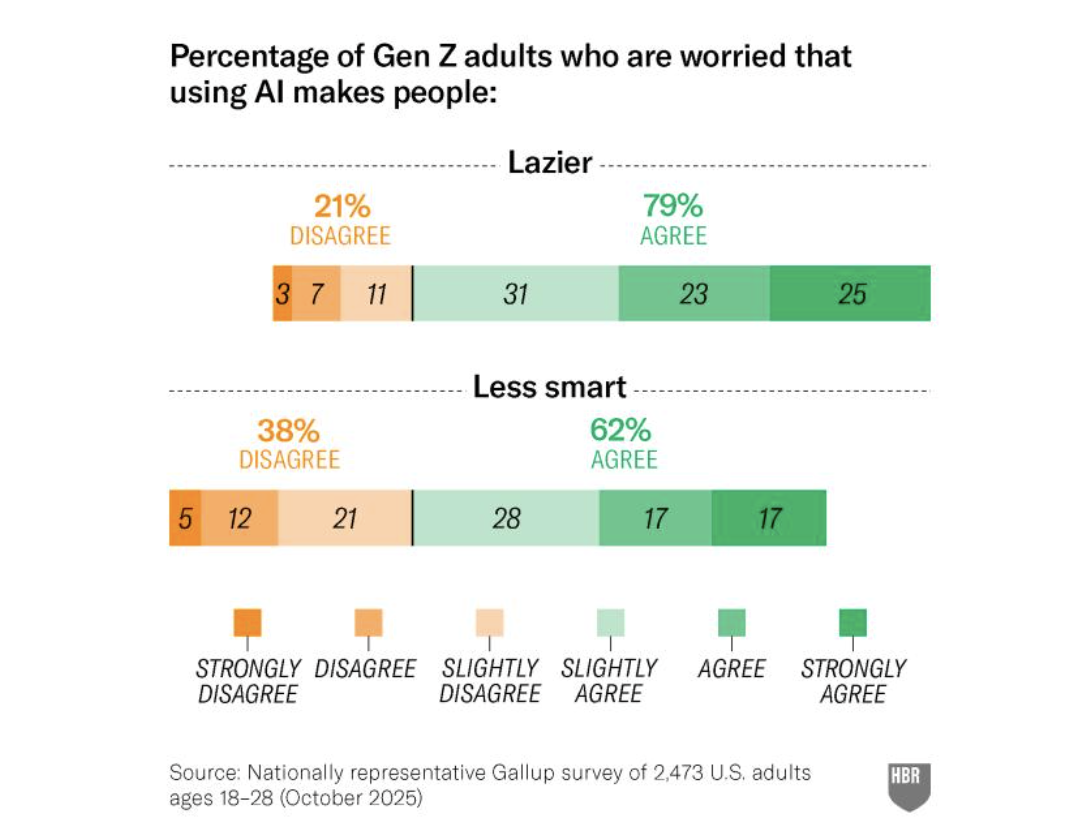
This ambivalence reflects a generation that’s both eager to use AI and worried about its effects—exactly the mindset that smart managers can work with. The key is designing early-career experiences that harness AI to accelerate learning rather than replace it.
The entry‑level drought—with one bright spot
Gen Z (born 1997–2012) enters the workforce during a challenging period. Randstad’s Gen Z Workplace Blueprint shows global entry‑level postings down 29 percentage points since January 2024, with tech junior roles down 35 points and finance down 24. There is light, though: healthcare bucks the trend (+13 points).
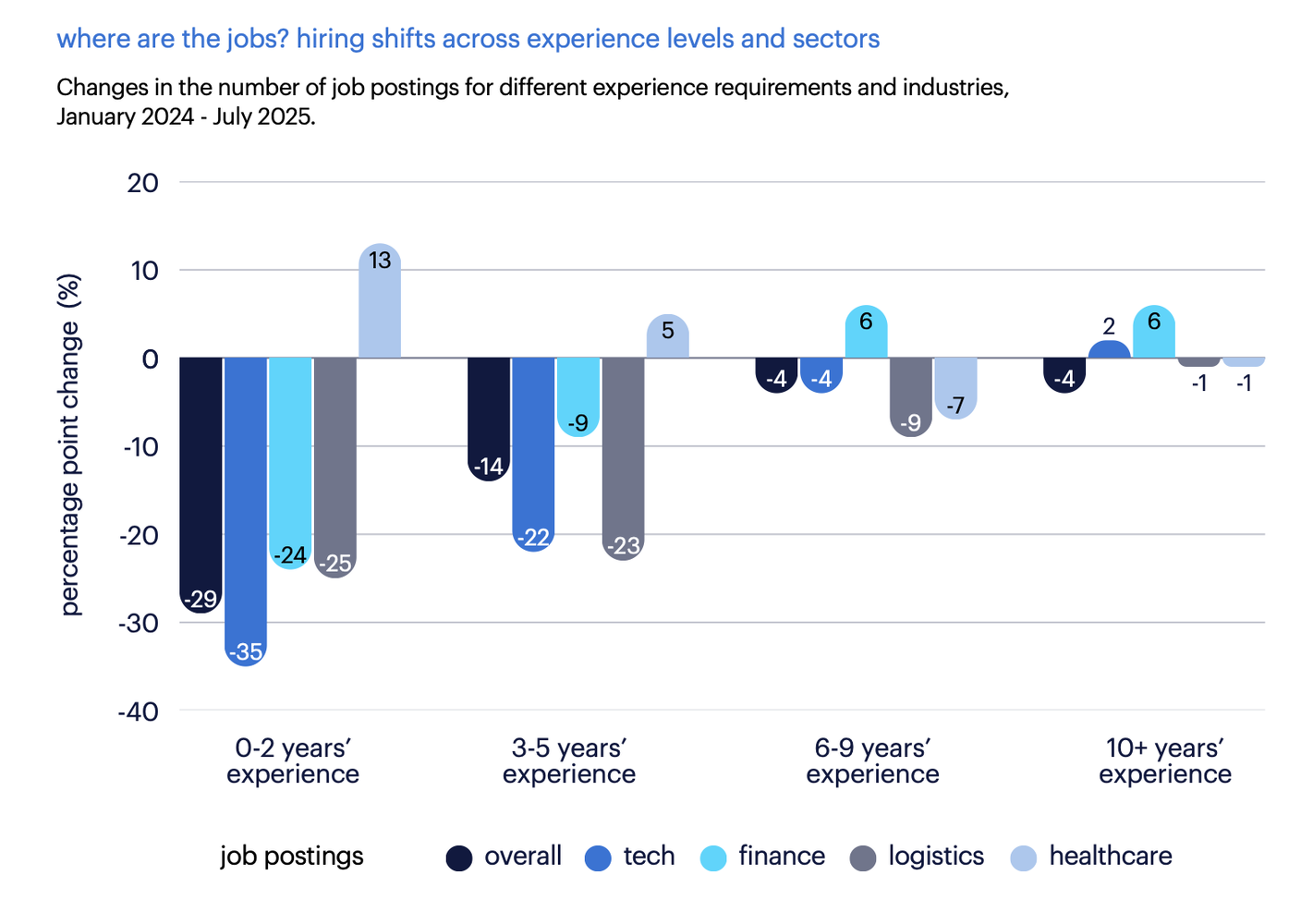
Despite this tight market, Gen Z remains ambitious—55% already use AI to problem‑solve and 58% are excited about AI. However, short tenures and a 22% attrition rate suggest they’re not finding the progression and skill growth they expect. This creates the core management challenge: how do you develop talent that’s AI-savvy but worried about AI’s effects, ambitious but quick to leave when growth stalls?
A thought experiment for hiring freezes
Under hiring freezes, you might imagine cost pressures nudging organizations toward early‑career roles, but historically, tight budgets compress these opportunities rather than expand them. This creates pressure toward alternative education pathways.

Midway through my own kids’ decision‑making, one seriously considered an atelier model: one‑on‑one mentorship to build targeted industry skills, a demonstrable portfolio, and access to a professional network for a fraction of a degree’s cost. In highly technical fields where very few faculty are active at the frontier, that approach offers direct, personalized relevance that traditional education can’t match.
Whether or not entry-level hiring rebounds, this points to what Gen Z values: visible skill development, mentored learning, and portfolio-building. Smart managers can create these conditions and build digital literacy for employees within existing roles.
Two moves for managers
Here’s where the AI ambivalence and portfolio-first thinking converge into actionable management strategy:
- Build substantive micro‑progression. Gen Z needs visible, regular movement—not a five‑year wait. Publish monthly or quarterly skill badges tied to real projects and make recognition public (certificates, announcements, demo days). Where possible, pair badges with small pay steps. Across the five universities where I’ve worked, micro‑progression is rare and existing HR structures make it challenging; start small with one pilot team, one skill ladder, or one public cadence.
- Redesign onboarding for learning quality and AI safety. Create 30/60/90‑day plans that allocate mentor time and document AI use to deepen, not deskill. Teach data hygiene (remove sensitive data; use sanctioned tools) and emphasize capability‑enhancing use cases: break complex problems into components, compare sources, and draft then revise with human judgment.
These moves work because they align with Gen Z’s instincts: they want visible progress, they’re comfortable with AI but worried about over-reliance, and they value mentored learning. You’re not fighting their preferences—you’re channeling them into retention and development.

The job for managers—and parents
As a parent, I’ve learned that Gen Z will choose the path that speeds skills and credibility, whether that’s a traditional degree, an atelier model, or something else. As managers, our opportunity is to make our organizations the place where that quick growth happens. By building micro-progression and AI-enhanced learning into the work itself, we turn Gen Z’s pragmatism into competitive advantage—for them and for us.
The generation that’s both excited about AI and worried about its effects isn’t confused. They’re realistic. The managers who design work to harness that will keep the best talent engaged, growing, and contributing.
Have you seen this in your workplace?
References:
- Lira, B., Folk, D., Ungar, L., & Duckworth, A. L. (2026, January 28). How Gen Z uses gen AI—and why it worries them. Harvard Business Review.
- The Gen Z workplace blueprint. Randstad.
- C., Anderson, M., Sidoti, O., & Bishop, W. (2026, February 24). How teens use and view AI. Pew Research Center.
- Gallup Inc. (2025). Walton Family Foundation–Gallup Voices of Gen Z study: Year 3 annual report.