

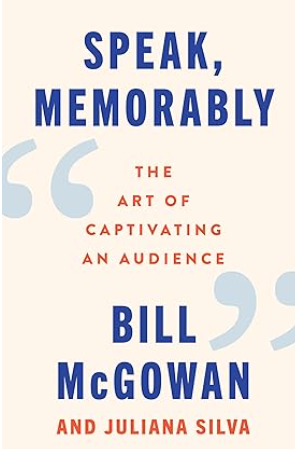
Most professionals approach communication backwards. They focus on being “on message”—safe, polished, forgettable. Bill McGowan and Juliana Silva argue this is exactly wrong. In Speak, Memorably: The Art of Captivating an Audience, they make a compelling case that what’s safe is rarely sticky, and in today’s crowded communication landscape, being forgettable is the real risk.
Three Big Takeaways
1. Memorability is the prime directive.
Every time you speak—whether in a small meeting, an all-hands gathering, or a client pitch—you’re auditioning for the next opportunity. McGowan frames it bluntly: “If you say something that rattles around in people’s brains for a few hours, a few days, or longer, you’ve hit the communications jackpot.” The goal isn’t to avoid mistakes. It’s to be remembered.
2. Brevity signals mastery.
McGowan invokes Einstein: “If you can’t explain it simply enough, you don’t understand it well enough.” Brevity has a direct correlation to knowledge and preparedness. Overtalking often stems from anxiety, poor preparation, or fear that omitting a single detail will make you look less thorough. The opposite is true. Concision conveys command.
3. Structure determines impact.
The authors introduce the Coppola Storytelling Formula: take your best material and make it the ending, your second-best the beginning, and put everything else in between. This primacy/recency effect ensures audiences remember your strongest points—because cognitive science shows we retain beginnings and endings far better than middles.

Three Reality Checks
1. Only 7% of your impact comes from your words.
Research cited in the book reveals that 55% of communication impact comes from body language, 38% from vocal delivery, and just 7% from actual content. Most professionals obsess over slides and scripts while ignoring how they physically show up.
I experienced this firsthand. I do a lot of virtual presentations, and while I enjoy them, they’re unsettling—you rarely get visual or verbal feedback, and you never know who’s multitasking. Recently, while giving an in-person presentation to about twenty people, I was overwhelmed by the difference in the experience. The energy, the engagement, the enthusiasm coming back at me—it transformed my delivery. The funny thing? It was 95% the same presentation I give virtually. Same content. Completely different impact.

2. Stories make facts 20 times more memorable.
Cognitive psychologist Jerome Bruner’s research shows we’re twenty times more likely to remember a fact when it’s wrapped in a story. Yet most business presentations are pure data dumps, stripped of narrative context.
3. It takes eight positive encounters to recover from one bad first impression.
The authors cite a Harvard study’s findings: If you get off on the wrong foot, you need eight subsequent positive interactions to change someone’s negative opinion. The stakes of those first moments are higher than most realize.
Why This Matters in the Age of AI
Here’s the twist that makes this book unexpectedly timely: AI is now analyzing human communication—and catching the fakers. The authors note that AI tools can detect scripted positivity on corporate earnings calls, distinguishing genuine conviction from rehearsed spin. The only group AI struggles to read? Trained actors.
This reveals something crucial: as AI becomes better at generating content, the distinctly human skills—authentic presence, emotional resonance, memorable phrasing—become more valuable, not less. AI can write your talking points. It cannot deliver them with conviction. It cannot read the room, pause for effect, or smile in a way that makes an audience trust you.
In a world flooded with AI-generated text, the professionals who can captivate a live audience will stand apart. The “Magnificent Seven” techniques McGowan outlines—analogy, creative labels, twisted clichés, wordplay, data with context, original definitions, and mathematical equations—are distinctly human tools for making ideas stick.

Conclusion
Communication isn’t a soft skill. It’s one of several digital leadership skills. As Simon Sinek puts it: “Simple ideas are easier to understand. Ideas that are easier to understand are repeated. Ideas that are repeated change the world.” McGowan and Silva show you how to develop those simple, repeatable ideas.
Speak, Memorably is practical, research-backed, and immediately applicable. If you present, lead meetings, or pitch ideas, this book will change how you prepare and deliver. Read it before your next high-stakes moment.
Reference: McGowan, B., & Silva, J. (2024). Speak, memorably: The art of captivating an audience. HarperCollins.