
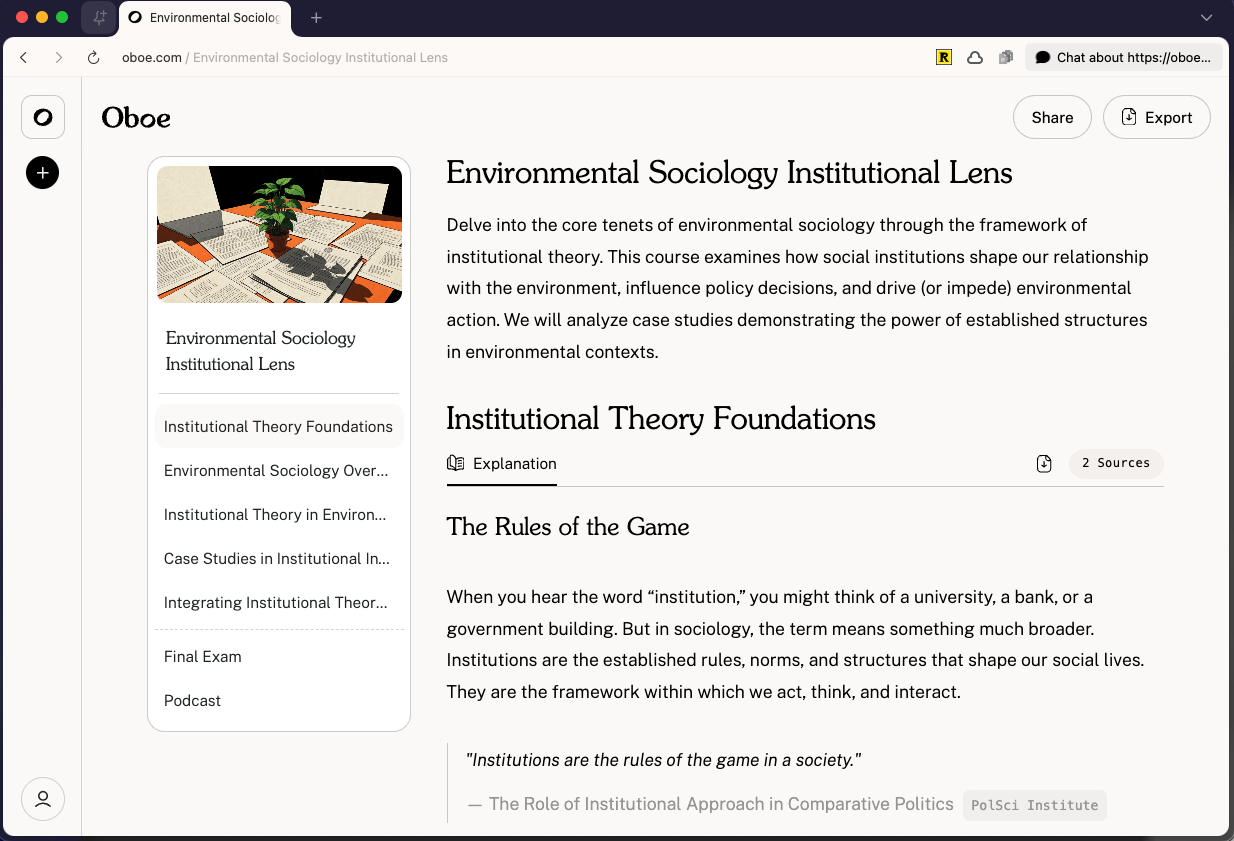
Oboe is a lightweight course generator: you give it a prompt, and it builds a short, structured learning path with text, images, quotes, flashcards, quizzes, and a final exam. It’s early, but it’s interesting—especially if you care about learning quickly by turning curiosity into a clear path.
What Oboe is
- A prompt-to-course tool. You start with a question or topic; Oboe turns it into a mini-course.
- A clean, low-cognitive-load interface. Navigation is minimal, sections are short, and you always know what to do next.
- A mixed-format study flow. Mostly text, but it can include images, quotes, flashcards, quizzes, podcasts, and a final exam. Some sections cite sources (in my tests, often Wikipedia).
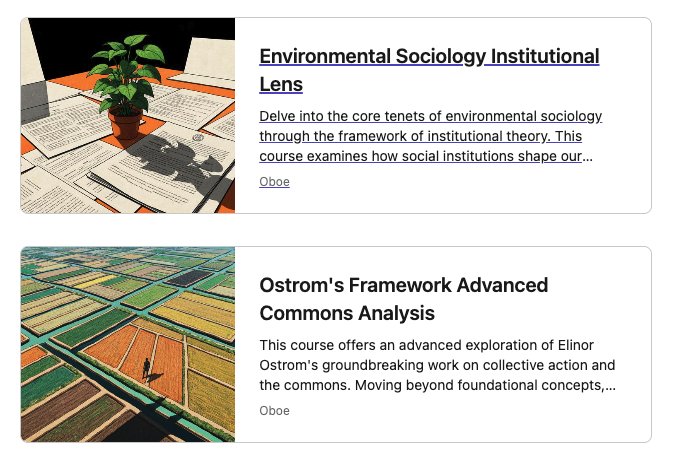
Two example prompts I used:
- “I want to learn about Environmental Sociology from an Institutional Lens.”
- “How can Elinor Ostrom’s work on Collective Action help us address contemporary environmental challenges.”
Here are the courses Oboe generated:
💚 Small UX touch I love: instead of “Next,” the button says “Advance.” It fits the mindset—self-directed learning to advance yourself.
Why it matters for learning fast

In a time of uncertainty and rapid change, the edge is not just knowledge—it’s accelerating the path from question to clarity. Oboe shines as:
- A fast starting point. It compresses the “where do I begin?” phase into minutes.
- A structure generator. Even if you later outgrow the course, the outline helps you see the key concepts and sequence your study.
- A retrieval scaffold. Flashcards, quizzes, and a final exam nudge you toward active recall, which is essential for learning efficiently.
How to get the most from Oboe
- Pro tip: start with a topic you know well. You’ll calibrate quality and spot gaps or nuances fast.
- Treat it as a launchpad, not a destination. Use the outline to drive deeper reading, expert videos, or papers.
- Add your own retrieval. Export or re-create flashcards in your spaced-repetition tool; revisit them on a schedule.
What I’d improve
- Pricing for downloads: $32/month feels steep for short courses, especially if you primarily use Oboe as a jumping-off point.
- Next steps: after the final exam, I want three concrete follow-ups—books, videos, or open courses—to push beyond the generated content.
- Sources: list every source at the end of the course, not just inline citations. Full bibliographies build trust and momentum for deeper study.
Bottom line
Oboe is a useful accelerator for the first 10–20% of learning—framing the domain, naming the parts, and giving you lightweight retrieval practice. Pair it with better sources and spaced repetition, and it can help you learn faster with less friction.
For more about Oboe, hear from its founder:
More accelerated learning techniques here.